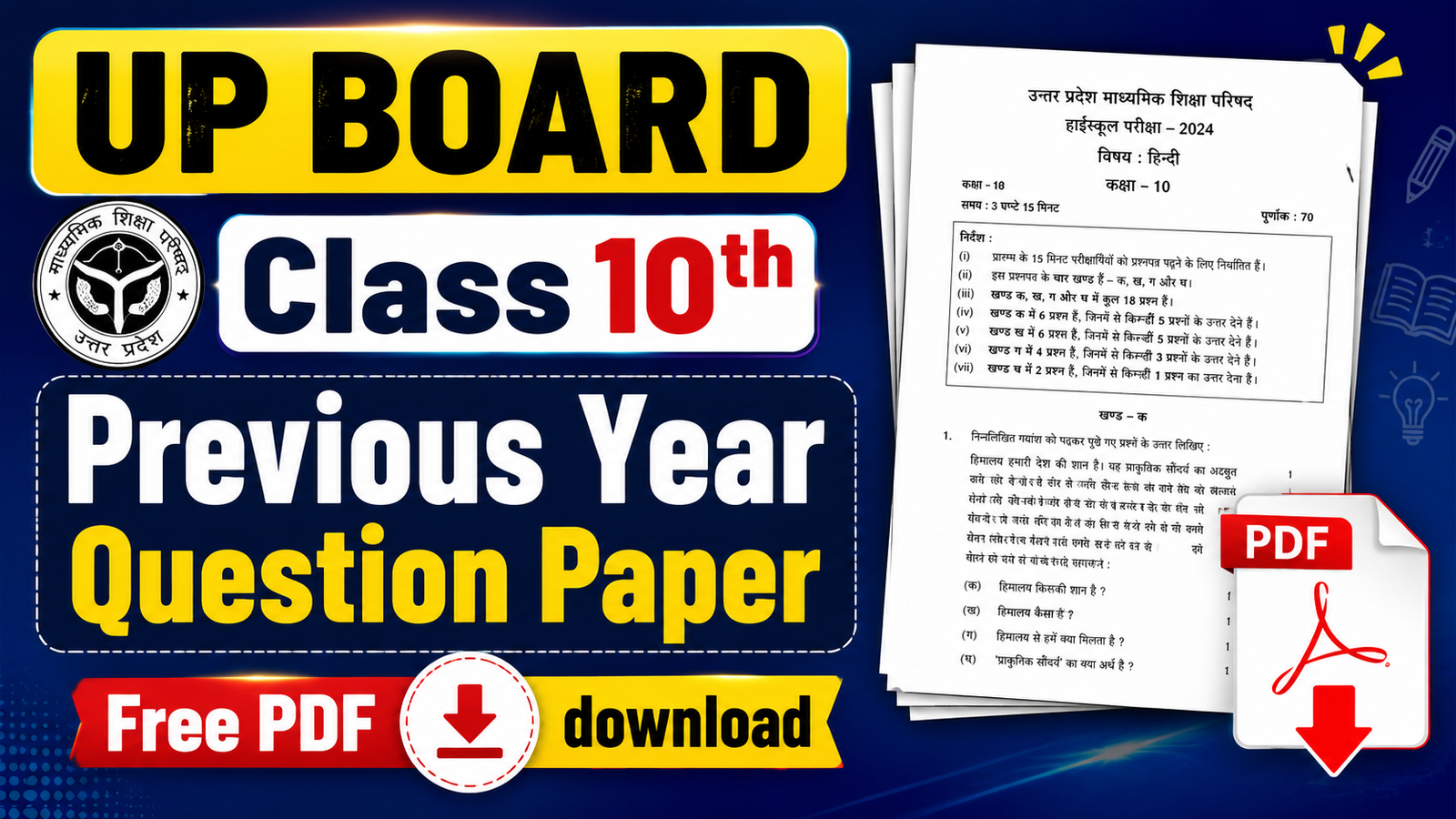
UP Board Class 12 Previous Year Question Paper
UP Board Class 12 English First Paper Question Paper 2012 – Free PDF Download
UP Board CLASS 12 PREVIOUS YEAR QUESTION PAPER
English-First Paper - 2012
Previous Year Question paper Class 12 with Free PDF download Link
Free PDF Download Link Available in last of the question Paper / Post
INTERMEDIATE EXAMINATION, 2012
English-First Paper
Time: 3 Hours 15 Min.
322 (HL)
Max. Marks: 50
UP Board Class 12 English First Paper Question Paper 2012 , UP Board, UP Board Class 12, UP Board 12th, UP Board Exam, UP Board Exam Paper, English, English First Paper, English Question Paper, UP Board English, UP Board Class 12 English, UP Board 12th En
UP Board CLASS 12 PREVIOUS YEAR QUESTION PAPER
English-First Paper - 2012
-
Explain with reference to the context one of the following passages: (a) Passion is not power; it is the abuse of power, the dispersion of power. Passion is like a furious storm which beats fiercely and wildly upon the embattled rock, whilst power is like the rock itself which remains silent and unmoved through it all. (b) Magnanimity and mercy were the noblest attributes of man. In the exercise of these high qualities, I could recover my prestige. At present, I was a ridiculous figure, a thing for laughter and derision. By being merciful, I could reassert the moral dignity of man and go back to my corner with honour. (c) This time the Creator took care to employ only a little of the harder materials. To the new animal He made, He gave neither horns nor claws; He gave it teeth that could chew but not bite. The energy He gave it was enough to make it useful on the battle-field, but He gave it no taste of its own for battles.
-
Select one of the following passages and answer the questions that follow: (a) Today, when the conception of nationalism has developed much more, Indians in foreign countries inevitably form a national group and hang together for various purposes, in spite of their internal differences. An Indian Christian is looked upon as an Indian wherever he may go. An Indian Moslem is considered an Indian in Turkey or Arabia or Iran or any other country where Islam is the dominant religion. (i) What do you understand by the expression 'conception of nationalism'? (ii) How do Indians live in foreign countries? (iii) Does an Indian Christian in England become an Englishman? (iv) Where is Islam the dominant religion?
(b) Compassion, 'daya', is the quality which is more characteristic of women than of men. I read recently a book which speaks about the decline of womanhood, and says that this is so because there is a decline in compassion. In other words, the natural quality of women is compassion. If you do not have compassion, you are not human. It is therefore, essential for every human being to develop the quality of considerateness, kindness and compassion. Without these qualities, we are only human animals, 'nara pasu', not more than that. (i) What distinguishes a woman from a man? (ii) What is the decline of womanhood due to ? (iii) When is a man not human? (iv) What do we lose if we do not have these qualities?
-
Answer two of the following questions in not more than 30 words each: (a) What are the three things necessary to free thinking? (b) How did Tom blackmail his brother George? (c) What is the commonest form of forgetfulness?
-
Answer one of the following questions in not more than 150 words: (a) "Sweet are the uses of adversity." Justify this in the light of the lesson 'My Struggle for An Education.' (b) What Chief features of the Indian culture have been emphasized by A.L. Basham?
-
Fill in the blanks in the following sentences selecting the most suitable word from those given within the brackets: (a) In the fable, the grasshopper stands for ....... (hard work, kindness, enjoyment, industry) (b) I bought one tiny ....... for a few annas. (fan, cup, pencil, basket) (c) Ordinarily, good memory is so common that we regard a man who does not possess it as ....... (eccentric, inefficient, inconsiderate, prosaic) (d) True health and ....... success go together. (positive, true, immortal, sincere)
-
Answer one of the following questions in not more than 150 words: (a) What are the four stories that form the basis of the play 'The Merchant of Venice'? Are they interconnected? (b) Give your opinion of the character of Antonio.
-
Answer one of the following questions in not more than 30 words: (a) Why did the Prince of Morocco choose the golden casket? (b) What is Shylock's reply to Antonio's request for a loan?
-
Answer one of the following questions in not more than 150 words: (a) Describe the plight of Gafur and the factors responsible for it. (b) Describe the psychology of childhood as it is presented in the story "The Lost Child".
-
Answer one of the following questions in about 30 words: (a) Where did Sanku work? What were his problems? (b) Why did Gyan Babu's wife tell him to put in his resignation?
-
Explain with reference to the context two of the following extracts: (a) The old order changeth, yielding place to new, And God fulfils Himself in many ways Lest one good custom should corrupt the world. (b) How happy is he born or taught, That serveth not another's will; Whose armour is his honest thought, And simple truth, his utmost skill! (c) I see a lily on thy brow, With anguish moist and fever dew; And on thy cheeks a fading rose, Fast withereth too.
-
Give the Central idea of one of the following poems: (a) The True Beauty (b) O Captain! My Captain! (c) The Song of the Free.
-
Answer one of the following questions in about 150 words: (a) Why was Siddhartha unhappy even among the pleasures and luxuries of the world? (b) What lesson do you draw from the story, "The Light of Asia"?
-
(a) Define Personification or Apostrophe and give an example of it. (b) Point out the figures of speech in two of the following: (i) So like a shattered column lay the king. (ii) He is now in the sunset of his days. (iii) All the perfumes of Arabia will not sweeten this little hand.
INTERMEDIATE EXAMINATION, 2012 English-Second Paper Time: 3 Hours 15 Min. 323 (EL) Max. Marks: 50
-
(a) Change the following into indirect form of speech: (i) The wolf said to the lamb, "Why are you making the water dirty?" (ii) The wolf said, "You have become very talkative. Be silent otherwise I will eat you."
-
(b) Combine the following sentences as directed within the brackets: (i) It is not known. When he will arrive. (into simple sentence) (ii) He worked hard. He wanted to pass. (into complex sentence)
-
(c) Transform the following sentences as directed within the brackets: (i) He is too miserly to spend any money. (into negative sentence) (ii) He may send his servant, if he does not come. (into passive voice)
-
(d) Correct four of the following sentences: (i) I have come at Varanasi a month ago. (ii) He prevented me to do it. (iii) Gopal is ill for four days. (iv) The rise and fall of the tide are due to the moon. (v) The news of the war are good today. (vi) One should not boast of his wealth.
-
Use three of the following idioms/phrases in your own sentences so as to make their meanings clear: (a) castles in the air (b) at home in (c) at the eleventh hour (d) hue and cry (e) to and fro.
-
(a) Give the antonyms of the following words: (i) disclose (ii) acknowledge.
-
(b) Give the synonyms of the following words: (i) humble (ii) mad.
-
(c) Substitute one word for the following expressions: (i) One who looks at the dark side of things. (ii) A person who can neither read nor write.
-
(d) Use the following words in sentences of your own so as to bring out the difference in their meanings clearly: (i) temporary (ii) temporal
PART-I
-
(a) Translate the following into English: जुलाई का महीना था। अत्यधिक गर्मी और घुटन थी। मैं स्कूल के लिए चल पड़ा। अचानक आकाश में बादल छा गये। शीतल हवा बहने लगी। सूरज घने बादलों में छिप गया। बादल गरजे, और बिजली चमकने लगी। झमाझम पानी बरसने लगा। सड़कों पर पानी ही पानी दिखाई पड़ने लगा। छोटे बच्चे बरसात का आनन्द ले रहे थे। एक घण्टे बाद बारिश रुकी। मैं पूरी तरह भीग गया था। जब स्कूल पहुँचा तो पता चला कि प्रधानाचार्य महोदय ने वर्षा-दिवस की घोषणा कर दी थी।
-
(b) Translate the following into Hindi: Man is the architect of his own fate. If he makes a proper division of his time and does his duties accordingly, he is sure to improve and prosper in life, but if he does otherwise, he is sure to repent. When he finds himself and is not able to recall the lost day, he will cry over the spilt milk. To kill time is as culpable as to commit suicide, for our life is nothing but the sum total of hours, days and years. Youth is the golden season of life. In youth the mind is pliable and soft and can be moulded into any form we like. If we lose the morning hours of life, we shall have to repent afterwards. If we sow a good seed, we shall reap a good harvest, when we grow up.
OR
-
Write an essay on one of the following topics in about 250 words: (a) Types of people you dislike. (b) The most pressing problems of our country today. (c) India of your dreams. (d) Science has made man its slave. (e) Duties of students in free India.
-
Write an application to the Principal of your college requesting him to grant you leave for one week to look after the arrangements of your brother's wedding. OR Write a letter to the editor of a newspaper, complaining against frequent break-down in electric supply of your town. (Note: Do not write your name and address in the letter).
-
Read the following passage carefully and answer the questions that follow : Among the many misfortunes that can befall a man, the loss of health is one of the severest. All the joys that life can give, cannot outweigh the suffering of the sick. Give the sick man everything and leave his sufferings and he will feel that half the world is lost to him. Lay him on silken bed still he will groan sleepless under the pressure of his sufferings, while the miserable beggars with health sleep sweetly on the hard ground. Spread his table with dainty and choicest foods, he will thrust away the hand that offers them and envy the poor man who enjoys his piece of dry bread. He would dream himself happy if he could enjoy the health of meanest of his servants. (a) Choose the right answer and complete the sentence: The greatest misfortune that can befall a man is (i) the loss of health (ii) denial of best food (iii) the loss of wealth (b) What is meant by, 'if he could enjoy the health of meanest of his servants'? (c) Give a suitable title to the given passage. (d) Explain one of the portions underlined. (e) Give a summary of the given passage.
Quarry Solved ;
- UP Board Class 12 English Previous Year Exam
- UP Board Class 12 English Previous Year Question Paper
- UP Board Class 12 English Exam Paper
- UP Board Class 12 English Question Paper 2012
- UP Board 12th English Question Paper 2012
- UP Board Class 12 English Previous Year Paper 2012
- UP Board Class 12 English 2012 PDF
- UP Board 12th English 2012 Question Paper PDF
- UP Board English Exam 2012
- UP Board Class 12 English Paper 2012
- UP Board Class 12 English First Paper 2012
- UP Board Class 12 English First Question Paper 2012
- UP Board 12th English First Paper 2012
- UP Board Class 12 English Free PDF Download
- UP Board Class 12 English Question Paper 2012 Free PDF Download