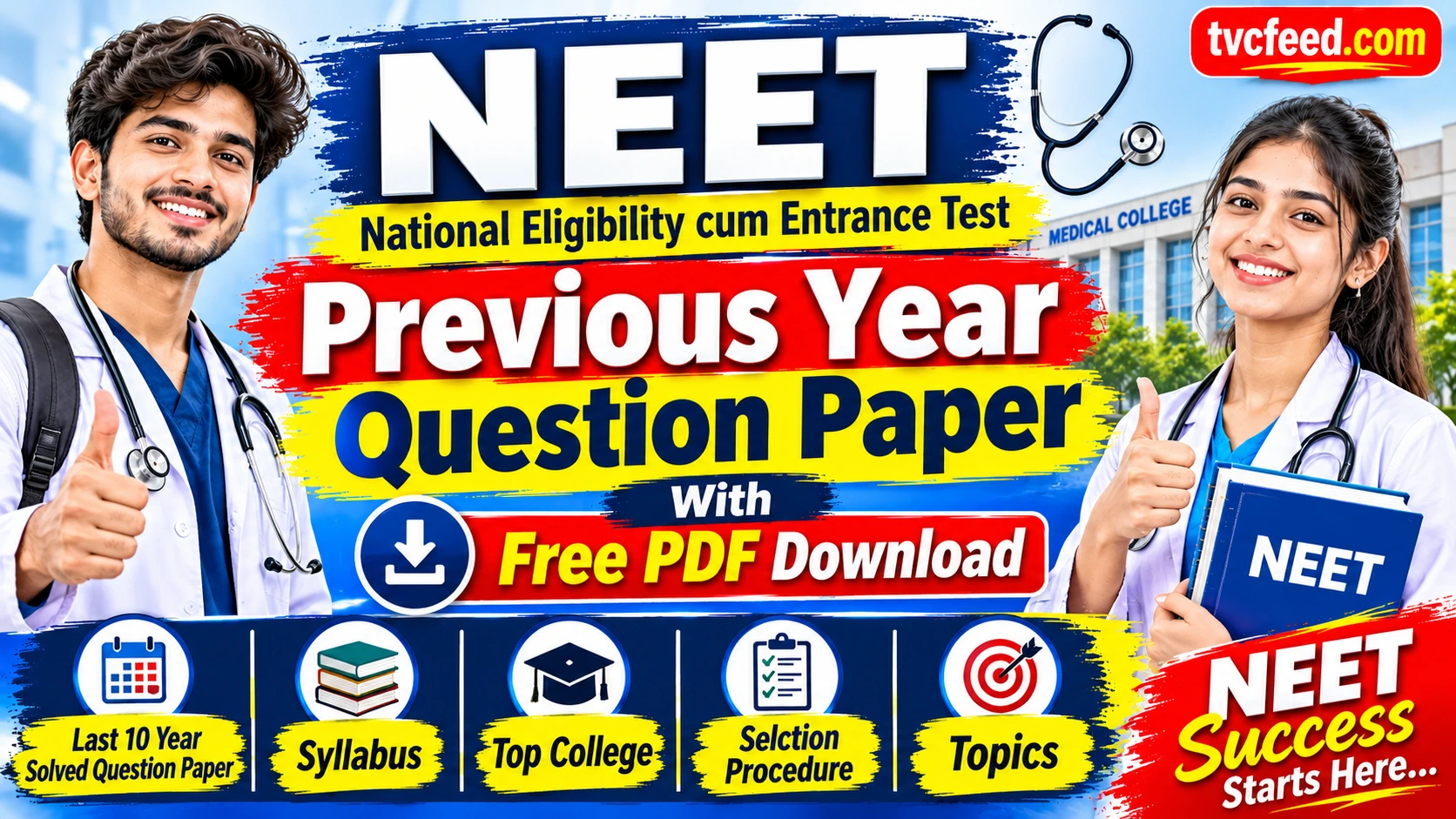
NEET Previous Year Papers 2015–2026 with Solutions PDF
Last updated: 15 November 2026 | Reading time: about 15 minutes
Table of Contents
- Why This NEET Paper Hub Is Useful
- Important Update: NEET 2026 Was Held Twice
- NEET Last 10 Years Solved Question Papers (2015–2026) with Free PDF Links
- Why You Should Solve NEET Previous Year Papers
- NEET Exam Pattern and Marking Scheme
- NEET Eligibility Criteria
- NEET Selection Procedure (Step by Step)
- NEET Counselling: MCC vs State Quota
- NEET Syllabus (Physics, Chemistry, Biology)
- Important and High-Yield Topics
- NEET Results, Cut-offs and Toppers (2024–2026)
- Best Medical Colleges for NEET (MBBS)
- MBBS Seats in India
- How to Use Previous Year Papers: 4-Week Plan
- Best Books for NEET
- 7 Mistakes That Waste Your PYQ Practice
- NEET 2027: What We Know So Far
- Frequently Asked Questions (FAQs)
- Official Websites to Verify Information
Why This NEET Paper Hub Is Useful
Every year, more than 20 lakh students compete for a limited number of medical seats in India. Solving previous year question papers (PYQs) is one of the most practical ways to understand how NEET actually tests your NCERT knowledge. This page puts everything in one place: papers, patterns, syllabus, selection process and colleges.
Important note on solutions: NTA publishes official answer keys. It does not publish step-by-step solutions. The solutions linked on this page are prepared by education experts and coaching platforms, so always match your answers with the NTA answer key for the same year and the same booklet code.
Important Update: NEET 2026 Was Held Twice
Many websites mix up the two 2026 papers. Here is the correct picture:
- 3 May 2026 (original exam): Held for about 22.79 lakh registered candidates. Booklet Codes 11, 12, 13, 14. NTA cancelled this exam on 12 May 2026 after paper-leak allegations, and the CBI took over the investigation. Use this paper for practice only.
- 21 June 2026 (Re-NEET): Booklet Codes 50, 60, 70, 80. This is the official 2026 paper that decided the result. Nearly 20 lakh candidates appeared, and the result was declared on 16 July 2026.
Always check the exam date and booklet code before you compare your answers with any answer key.
NEET Last 10 Years Solved Question Papers (2015–2026) with Free PDF Links
Click the year you need. Each link opens the question paper with solutions and the PDF download option. Match the year + booklet code on your paper with the answer key.
NEET 2026 Question Papers
1. NEET Recent Years Solved Question Papers (2023 - 2026)
NEET Previous Year Question Paper 2026 Code 12 with Solutions – Free PDF Download
NEET Previous Year Question Paper 2026 Code 13 with Solutions – Free PDF Download
NEET Previous Year Question Paper 2026 Code 14 with Solutions – Free PDF Download
NEET Previous Year Question Paper 2025 Code 45 with Solutions – Free PDF Download
NEET Previous Year Question Paper 2025 Code 46 with Solutions – Free PDF Download
NEET Previous Year Question Paper 2025 Code 47 with Solutions – Free PDF Download
NEET Previous Year Question Paper 2025 Code 48 with Solutions – Free PDF Download
NEET Previous Year Question Paper 2024 Code Q1 with Solutions – Free PDF Download
NEET Previous Year Question Paper 2024 Code Q2 with Solutions – Free PDF Download
NEET Previous Year Question Paper 2024 Code Q3 with Solutions – Free PDF Download
NEET Previous Year Question Paper 2024 Code Q6 with Solutions – Free PDF Download
NEET Previous Year Question Paper 2024 Code R1 with Solutions – Free PDF Download
NEET Previous Year Question Paper 2024 Code S1 with Solutions – Free PDF Download
NEET Previous Year Question Paper 2024 Code S5 with Solutions – Free PDF Download
NEET Previous Year Question Paper 2023 Code E1 with Solutions – Free PDF Download
NEET Previous Year Question Paper 2023 Code E2 with Solutions – Free PDF Download
NEET Previous Year Question Paper 2023 Code F1 with Solutions – Free PDF Download
NEET Previous Year Question Paper 2023 Code F2 with Solutions – Free PDF Download
NEET Previous Year Question Paper 2023 Code G1 with Solutions – Free PDF Download
NEET Previous Year Question Paper 2023 Code H1 with Solutions – Free PDF Download
2. NEET Previous Years Question Papers Archive (2022 - 2015)
NEET Previous Year Question Paper 2022 Code R1 with Solutions – Free PDF Download
NEET Previous Year Question Paper 2022 Code R2 with Solutions – Free PDF Download
NEET Previous Year Question Paper 2022 Code S1 with Solutions – Free PDF Download
NEET Previous Year Question Paper 2022 Code S2 with Solutions – Free PDF Download
NEET Previous Year Question Paper 2022 Code T1 with Solutions – Free PDF Download
NEET Previous Year Question Paper 2022 Code T2 with Solutions – Free PDF Download
NEET 2021 Previous Year Question Paper Q1 with Solutions – Free PDF Download
NEET 2021 Previous Year Question Paper Q2 with Solutions – Free PDF Download
NEET 2021 Previous Year Question Paper P1-II with Solutions – Free PDF Download
NEET 2021 Previous Year Question Paper P2 with Complete Solutions – Free PDF Download
NEET 2021 Previous Year Question Paper P2 with Solutions – Free PDF Download
NEET Previous Year Question Paper 2021 with Solutions – Code P1 | Physics, Chemistry & Botany-Zoology | Free PDF Download
NEET Previous Year Question Paper 2020 with Solutions – Code F1 | Physics, Chemistry & Biology | Free PDF Download
NEET Previous Year Question Paper 2020 with Solutions – Code F2 | Physics, Chemistry & Biology | Free PDF Download
NEET Previous Year Question Paper 2020 with Solutions – Code G1 | Physics, Chemistry & Biology | Free PDF Download
NEET Previous Year Question Paper 2020 with Solutions – Code G2 | Physics, Chemistry & Biology | Free PDF Download
NEET Previous Year Question Paper NEET UG 2019 with Solutions Code-Q1| Physics, Chemistry & Biology | Free PDF Download
NEET Previous Year Question Paper NEET UG 2019 with Solutions Code-Q2| Physics, Chemistry & Biology | Free PDF Download
NEET Previous Year Question Paper NEET UG 2019 with Solutions Code-R1| Physics, Chemistry & Biology | Free PDF Download
NEET Previous Year Question Paper NEET UG 2019 with Solutions Code-S1| Physics, Chemistry & Biology | Free PDF Download
NEET Previous Year Question Paper NEET UG 2019 with Solutions Code-S2| Physics, Chemistry & Biology | Free PDF Download
NEET Previous Year Question Paper NEET UG-2018 with Solutions Code-EE| Physics, Chemistry & Biology | Free PDF Download
NEET Previous Year Question Paper NEET UG-2018-II with Solutions | Physics, Chemistry & Biology | Free PDF Download
NEET Previous Year Question Paper NEET UG-2018 with Solutions | Physics, Chemistry & Biology | Free PDF Download
NEET Previous Year Question Paper 2017 with Solutions Code-S| Physics, Chemistry & Biology | Free PDF Download
NEET Previous Year Question Paper 2017 with Solutions Code-D| Physics, Chemistry & Biology | Free PDF Download
NEET Previous Year Question Paper 2016 with Solutions Phase-1| Physics, Chemistry & Biology | Free PDF Download
NEET Previous Year Question Paper 2016 with Solutions | Physics, Chemistry & Biology | Free PDF Download
NEET Previous Year Question Paper 2015 with Solutions | Physics, Chemistry & Biology | Free PDF Download
Note: The 2015 paper was the AIPMT, the exam that came before NEET. NEET became the single national medical entrance exam in 2016. The 2015 paper is still very useful for practice.
Year-wise Quick Reference Table
| Year |
Exam date |
Booklet codes / sets |
Pattern |
| 2026 (Re-NEET) |
21 June 2026 |
50, 60, 70, 80 |
180 questions, compulsory |
| 2026 (cancelled) |
3 May 2026 |
11, 12, 13, 14 |
180 questions, compulsory |
| 2025 |
4 May 2025 |
45, 46, 47, 48 |
180 questions, compulsory |
| 2024 |
5 May 2024 (re-test on 23 June 2024 for 1,563 candidates) |
Sets Q, R, S, T |
200 questions (Section B optional) |
| 2023 |
7 May 2023 |
Sets E, F, G, H |
200 questions (Section B optional) |
| 2022 |
17 July 2022 |
Sets Q, R, S, T |
200 questions (Section B optional) |
| 2021 |
12 September 2021 |
Multiple codes |
200 questions (Section B optional) |
| 2020–2016 |
Various |
Various |
180 questions |
| 2015 |
— |
AIPMT |
Pre-NEET exam |
Why You Should Solve NEET Previous Year Papers
Reading NCERT gives you knowledge. Solving previous year papers shows you how that knowledge is tested. Here is what regular PYQ practice gives you:
- You learn the real question style. You see how NCERT lines are turned into statement-based, assertion-reason, match-the-column and diagram questions.
- You find your weak chapters. Your mistakes show you exactly which chapters need revision.
- You build speed. NEET gives you about one minute per question (180 questions in 180 minutes). Timed practice is the only way to build that speed.
- You reduce exam fear. When the exam hall feels familiar, panic goes down and accuracy goes up.
- You understand negative marking. Each wrong answer costs 1 mark, so practice teaches you when to guess and when to skip.
NEET Exam Pattern and Marking Scheme
| Subject |
Questions |
Marks |
| Physics |
45 |
180 |
| Chemistry |
45 |
180 |
| Botany |
45 |
180 |
| Zoology |
45 |
180 |
| Total |
180 |
720 |
- Question type: Multiple-choice questions with four options and one correct answer.
- Marking: +4 for a correct answer, −1 for a wrong answer, 0 for unattempted.
- Mode: Pen and paper (OMR sheet) in 2026.
- Languages: Offered in 13 languages, including English and Hindi.
- Biology weightage: Biology is 90 questions and 360 marks, which is half of the paper.
How the NEET Pattern Changed Over the Years
| Period |
Questions |
Duration |
Key point |
| 2016–2020 |
180, all compulsory |
3 hours |
Original NEET pattern |
| 2021–2024 |
200 (attempt 180) |
3 hours 20 minutes |
Section A: 35, Section B: 15 (attempt any 10) per subject |
| 2025–2026 |
180, all compulsory |
3 hours |
Section B removed |
Practice tip: When you solve a 2021–2024 paper, do all of Section A and 10 questions out of 15 in Section B. Then compare your score against the 180-question pattern.
NEET Eligibility Criteria
- Age: You must be at least 17 years old by 31 December of the admission year (31 December 2026 for the 2026 cycle). There is no upper age limit.
- Attempts: There is no limit on the number of attempts.
- Qualification: Class 12 (or equivalent) with Physics, Chemistry, Biology/Biotechnology and English.
- Minimum marks in PCB: General 50%, OBC/SC/ST 40%, PwBD (General) 45%, PwBD (reserved categories) 40%.
- Nationality: Indian citizens, NRIs, OCIs, PIOs and foreign nationals can apply.
Eligibility rules are fixed by the NTA information bulletin every year. Always read the bulletin of the year you are applying for.
NEET Selection Procedure (Step by Step)
Getting into an MBBS or BDS seat through NEET follows a clear sequence. Here is the full process in order:
- Check eligibility. Confirm your age, subjects and Class 12 marks.
- Apply online. Fill the application form at neet.nta.nic.in. Applications usually open in the first quarter of the year, and the exact dates are given in the information bulletin.
- Download the admit card. You get the city intimation slip first and the admit card a few days before the exam.
- Appear for the exam. 180 questions, 720 marks, OMR-based in 2026.
- Check the provisional answer key. NTA releases it with your OMR response sheet. A paid challenge window lets you object to an answer (the fee was ₹200 per question in the 2026 Re-NEET).
- Final answer key and result. NTA declares the result with your marks, percentile, All India Rank (AIR) and category rank.
- Register for counselling. Register with MCC (mcc.nic.in) for All India Quota seats and with your state authority for state quota seats.
- Fill and lock your choices. Choose colleges in order of preference, then lock them.
- Seat allotment. A seat is allotted based on your rank, category, choices and seat availability.
- Reporting and document verification. Report to the allotted college with your original documents and pay the fee.
- Admission and joining. Complete admission formalities and join the college within the given dates.
How NEET Ranks Are Decided
Your rank depends on your marks. If two candidates have the same marks, the NTA uses tie-breaking rules. These usually look at higher marks in Biology first, then Chemistry, then Physics, followed by fewer wrong answers. Check the current information bulletin for the exact order.
NEET Qualifying Cut-off (Re-NEET 2026)
| Category |
Qualifying percentile |
Qualifying marks (2026) |
| UR / EWS |
50th |
715–213 |
| OBC / SC / ST |
40th |
212–177 |
| UR / EWS (PwBD) |
45th |
212–194 |
Qualifying NEET only makes you eligible for counselling. A seat depends on your rank, so qualifying marks and admission marks are very different things.
Documents Usually Needed for Counselling
- NEET admit card and scorecard
- Class 10 and Class 12 marksheets and certificates
- Identity proof (Aadhaar, passport or similar)
- Recent passport-size photographs
- Category certificate (SC/ST/OBC-NCL/EWS) or PwBD certificate, if applicable
- Domicile or residence certificate (needed for most state counselling)
NEET Counselling: MCC vs State Quota
NEET counselling runs on two parallel tracks. Many students miss one of them, so understand both.
| Point |
MCC (All India Quota) |
State counselling |
| Conducted by |
Medical Counselling Committee (mcc.nic.in) |
Your state or UT authority |
| Seats covered |
15% of government college seats, plus 100% seats in AIIMS, JIPMER, central universities, deemed universities, ESIC and similar institutions |
85% of government college seats and seats in private colleges of that state |
| Who can apply |
NEET-qualified candidates from all states |
Mostly candidates with that state’s domicile (rules differ by state) |
- Rounds: In the 2026 cycle MCC held Round 1, Round 2, Round 3 and a Stray Vacancy Round.
- Fees (2026 cycle): For AIQ, central universities, AIIMS and JIPMER, registration was ₹1,000 for UR/EWS and ₹500 for SC/ST/OBC/PwD. For deemed universities it was ₹5,000 for all categories. A refundable security deposit also applies, and it is much higher for deemed universities.
- Reservation (All India Quota): 15% SC, 7.5% ST, 27% OBC-NCL and 10% EWS, with 5% horizontal reservation for PwBD.
- AYUSH seats: BAMS, BHMS, BUMS and BSMS All India Quota seats are handled by AACCC (aaccc.gov.in).
Fees, dates and rules change every year. Confirm them on the official MCC and state websites.
NEET Syllabus (Physics, Chemistry, Biology)
The NEET syllabus is prescribed by the National Medical Commission (NMC) and covers Class 11 and Class 12 topics. For NEET 2026 the NMC finalised the syllabus without removing any full chapters. The NEET syllabus is closely aligned with NCERT. Always download the official PDF from the NMC or NTA website for the exact topic list.
NEET Physics Syllabus
| Class 11 |
Class 12 |
- Physics and Measurement
- Kinematics
- Laws of Motion
- Work, Energy and Power
- Rotational Motion
- Gravitation
- Properties of Solids and Liquids
- Thermodynamics
- Kinetic Theory of Gases
- Oscillations and Waves
|
- Electrostatics
- Current Electricity
- Magnetic Effects of Current and Magnetism
- Electromagnetic Induction and Alternating Currents
- Electromagnetic Waves
- Optics (Ray and Wave Optics)
- Dual Nature of Matter and Radiation
- Atoms and Nuclei
- Electronic Devices
|
NEET Chemistry Syllabus
| Physical Chemistry |
Inorganic Chemistry |
Organic Chemistry |
- Some Basic Concepts of Chemistry (Mole Concept)
- Atomic Structure
- Chemical Thermodynamics
- Solutions
- Equilibrium
- Redox Reactions and Electrochemistry
- Chemical Kinetics
|
- Classification of Elements and Periodicity
- Chemical Bonding and Molecular Structure
- p-Block Elements
- d- and f-Block Elements
- Coordination Compounds
|
- Purification and Characterisation of Organic Compounds
- Some Basic Principles of Organic Chemistry (GOC)
- Hydrocarbons
- Organic Compounds Containing Halogens
- Organic Compounds Containing Oxygen
- Organic Compounds Containing Nitrogen
- Biomolecules
- Principles Related to Practical Chemistry
|
NEET Biology Syllabus (Botany and Zoology)
| Class 11 |
Class 12 |
- Diversity in the Living World
- Structural Organisation in Animals and Plants
- Cell Structure and Function
- Plant Physiology
- Human Physiology (digestion, breathing, circulation, excretion, locomotion, neural and chemical coordination)
|
- Reproduction
- Genetics and Evolution
- Biology and Human Welfare
- Biotechnology and Its Applications
- Ecology and Environment
|
The lists above give the main units. Subtopics, small additions and deletions are listed in the official NMC syllabus PDF, so verify them there before you finalise your study plan.
Important and High-Yield Topics
These topics appear often and carry strong marks for most students. Use them as a starting point, then confirm with your own analysis of previous year papers.
- Physics: Current Electricity, Electrostatics, Magnetism and EMI, Ray and Wave Optics, Modern Physics (Dual Nature, Atoms, Nuclei), Semiconductors, Thermodynamics, Laws of Motion, Work-Energy-Power, Rotational Motion.
- Chemistry: Chemical Bonding, Chemical Equilibrium, Thermodynamics, Electrochemistry, Chemical Kinetics, Coordination Compounds, p-Block and d-Block Elements, General Organic Chemistry, Hydrocarbons, Aldehydes, Ketones and Carboxylic Acids, Amines, Biomolecules.
- Biology: Human Physiology, Plant Physiology, Cell Structure and Cell Division, Genetics and Molecular Basis of Inheritance, Evolution, Reproduction, Biotechnology, Ecology, Biology and Human Welfare, Structural Organisation in Animals and Plants.
Smart tip: Biology is half the paper (360 of 720 marks), and Genetics and Evolution is one of its biggest units. Read NCERT Biology line by line, because many questions are built directly from NCERT statements, tables and diagrams.
NEET Results, Cut-offs and Toppers (2024–2026)
| Year |
Registered |
Appeared |
Qualified |
Top score |
UR/EWS cut-off |
| 2024 |
about 24.08 lakh |
about 23.33 lakh |
about 13.15 lakh |
720 (multiple toppers) |
162 |
| 2025 |
about 22.76 lakh |
about 22.09 lakh |
about 12.37 lakh |
686 |
144 |
| 2026 (Re-NEET) |
about 22.79 lakh (original registration) |
nearly 20 lakh |
about 11.21 lakh |
715 (joint AIR 1) |
213 |
- NEET 2025 topper: Mahesh Kumar (Rajasthan), 686 marks.
- Re-NEET 2026 toppers: Aryan Gupta (Punjab) and Panshul Bansal (Haryana), 715 marks each. 19 candidates scored above 700.
- Cut-off jump: The general qualifying cut-off rose from 144 in 2025 to 213 in 2026, a jump of 69 marks, because paper difficulty changes every year.
Best Medical Colleges for NEET (MBBS)
The table below uses the NIRF 2025 Medical ranking, the latest list verified at the time of writing. PGIMER Chandigarh (rank 2) and SGPGIMS Lucknow are top institutes, but they focus on postgraduate and super-specialty courses and do not offer MBBS.
| NIRF 2025 rank |
College |
City / State |
Type |
| 1 |
AIIMS New Delhi |
New Delhi |
Government (Institute of National Importance) |
| 3 |
Christian Medical College (CMC), Vellore |
Tamil Nadu |
Private (minority institution) |
| 4 |
JIPMER, Puducherry |
Puducherry |
Government (Institute of National Importance) |
| 6 |
Institute of Medical Sciences, BHU |
Varanasi, Uttar Pradesh |
Central university |
| 8 |
King George’s Medical University (KGMU) |
Lucknow, Uttar Pradesh |
State government university |
| 9 |
Amrita Vishwa Vidyapeetham |
Coimbatore / Kochi |
Deemed university (private) |
| 10 |
Kasturba Medical College (KMC), Manipal |
Karnataka |
Deemed university (private) |
Other widely respected government colleges include Maulana Azad Medical College (MAMC), Delhi, Lady Hardinge Medical College, Delhi, Armed Forces Medical College (AFMC), Pune and Sawai Man Singh Medical College, Jaipur. Newer AIIMS institutes across India also offer MBBS through MCC counselling.
Expected NEET Marks for Top Colleges (General Category, Estimates)
These are expert estimates, not official figures. Actual closing ranks change every year with paper difficulty, seats and the number of candidates.
| Seat type |
Approximate marks (General) |
| AIIMS institutes |
about 700–715+ |
| All India Quota (government colleges) |
about 615–630+ |
| State quota (government colleges) |
about 590–610+ |
How to Choose a College
- Prefer government seats when possible, because fees are much lower than private colleges.
- Check NMC recognition and the seat matrix of the college for that year.
- Compare total fees for the full 5.5-year course, not just the first year.
- Check clinical exposure, hospital size, faculty and internship stipend.
- Use previous year closing ranks from MCC and your state counselling website to build a realistic preference list.
MBBS Seats in India
The National Medical Commission’s latest revised seat matrix for 2026-27 lists 1,40,664 MBBS seats across 839 medical colleges, with about 64,000 government seats and 76,500 private seats. This count excludes Institutes of National Importance such as AIIMS and JIPMER. The number was revised more than once during the year, so check the NMC and MCC websites for the final figure.
With about 11.21 lakh qualified candidates in 2026, that is roughly 8 qualified candidates for every seat (a rough estimate that does not include INI seats). This is why every mark matters in counselling.
How to Use Previous Year Papers: A 4-Week Plan
- Week 1 – Learn the pattern. Solve two recent papers without a timer. Mark every wrong or guessed question.
- Week 2 – Add the clock. Solve one full paper every 2–3 days in 3 hours with an OMR sheet. Start with Biology, then Chemistry, then Physics, and adjust the order to your own speed.
- Week 3 – Analyse mistakes. Tag each wrong answer as concept, calculation, misread, guess or time. Fix the most common reason first.
- Week 4 – Revise and repeat. Re-solve your wrong questions without looking at the answers, then take two fresh papers under exam conditions.
Best Books for NEET
- Biology: NCERT Class 11 and 12 Biology (read every line, table and diagram). Add an objective question book for practice.
- Chemistry: NCERT Class 11 and 12 Chemistry for Physical, Inorganic and Organic. Add a good problem book for Physical and Organic.
- Physics: NCERT Class 11 and 12 Physics for concepts, plus H.C. Verma for understanding and an objective book for practice.
- Practice: Previous year papers (this page), chapter-wise MCQs and full-length mock tests.
7 Mistakes That Waste Your PYQ Practice
- Using the wrong answer key. Every booklet code has a different question order, so always match the code.
- Treating the cancelled 3 May 2026 paper as the official one.
- Solving without a timer.
- Comparing a 200-question paper directly with the current 180-question pattern.
- Checking only your score and not the reason behind each mistake.
- Skipping NCERT after a Biology error.
- Trusting a PDF without checking it against the NTA answer key.
NEET 2027: What We Know So Far
- The Education Minister announced on 15 May 2026 that NEET UG will become a computer-based test (CBT) from 2027.
- As of late October 2026, NTA had not published the NEET 2027 information bulletin or the exam date.
- Press reports mention multiple days and shifts, but this is not confirmed in an official bulletin.
- The 180-question, 720-mark structure is widely expected to continue, but only the official bulletin can confirm it.
Start practising some papers on a screen now, so the format does not surprise you.
Frequently Asked Questions (FAQs)
1. Where can I download NEET last 10 years solved question papers for free?
You can open the year-wise links in the papers section above to read each NEET question paper with solutions and download the free PDF.
2. Which NEET 2026 paper is official?
The Re-NEET held on 21 June 2026 (Codes 50, 60, 70, 80) is official. The 3 May 2026 paper (Codes 11–14) was cancelled and should be used for practice only.
3. How many questions are asked in NEET?
NEET has 180 compulsory multiple-choice questions: 45 each in Physics, Chemistry, Botany and Zoology. There is no Section B and no choice.
4. What is the NEET marking scheme?
You get +4 marks for a correct answer and lose 1 mark for a wrong answer. Unattempted questions get 0. The maximum score is 720.
5. How long is the NEET exam?
The scheduled duration is 3 hours (2 PM to 5 PM). The 21 June 2026 Re-NEET had a 3 hours 15 minutes window.
6. Does NTA release solved question papers?
No. NTA releases answer keys. Detailed solutions are prepared by education experts and coaching platforms, so match them with the NTA answer key for your booklet code.
7. What is the age limit for NEET?
The minimum age is 17 years by 31 December of the admission year. There is no upper age limit and no limit on the number of attempts.
8. How much percentage is needed in Class 12 for NEET?
General category candidates need at least 50% in Physics, Chemistry and Biology. OBC, SC and ST candidates need 40%. PwBD (General) candidates need 45%.
9. What is the selection process after NEET?
After the result, you register for counselling with MCC (for All India Quota, AIIMS, JIPMER, central and deemed universities) and with your state authority (for state quota seats). You then fill choices, get a seat allotted, verify documents and join the college.
10. How many MBBS seats are there in India?
The latest NMC seat matrix for 2026-27 lists about 1.4 lakh MBBS seats across 839 medical colleges, excluding Institutes of National Importance.
11. Which is the best medical college in India?
AIIMS New Delhi holds NIRF rank 1 in the 2025 Medical ranking. CMC Vellore, JIPMER Puducherry and IMS-BHU are also among the top MBBS colleges.
12. Is NEET 2027 going to be online?
The government has announced that NEET will be a computer-based test from 2027. Wait for the NTA information bulletin for the date, shifts and rules.
13. Are old papers from 2015–2018 still useful?
Yes, for concepts and practice. Those papers followed older patterns, so adjust how you score yourself.
14. Is solving previous year papers enough to crack NEET?
No. Use them together with NCERT, chapter-wise MCQs and timed mock tests. Their real value is that they show you where you lose marks.
Conclusion
NEET rewards students who understand NCERT deeply and practise under exam conditions. Use this page as your single hub: solve the papers year by year, match answers with the NTA key for your booklet code, analyse every mistake, and keep Biology at the centre of your preparation. Bookmark this page and check back for NEET 2027 updates.
Official Websites to Verify Information
- NTA / NEET: neet.nta.nic.in and nta.ac.in (bulletin, answer keys, results)
- Syllabus and seat matrix: National Medical Commission – nmc.org.in
- MBBS/BDS counselling: Medical Counselling Committee – mcc.nic.in
- AYUSH counselling: aaccc.gov.in
- College rankings: nirfindia.org
Disclaimer: This page is an independent educational resource and is not affiliated with NTA, NMC or MCC. Dates, fees, seat counts, cut-offs and rules can change, so always confirm final details on the official websites.